

In short: Paraphimosis is a foreskin that has been pulled back behind the head of the penis and will not go forward again. The tight ring of skin squeezes the head of the penis, so it needs treatment within hours, not days. At Sreshta Multi Speciality Hospitals, BHEL, the Emergency team treats it 24 hours a day, usually by bringing down the swelling and moving the foreskin back under a penile block (local anaesthesia).
If your foreskin is stuck now, come to Sreshta Emergency straight away or call +91 99988 86103 (open 24 hours).
Paraphimosis (para-fy-MOH-sis): a retracted foreskin that is trapped behind the head of the penis (glans) and cannot be returned over it. It happens only in men and boys who are not circumcised.
What is paraphimosis?
Paraphimosis happens when the foreskin is pulled back and cannot be returned to its normal position. The trapped skin forms a tight band behind the glans, which causes swelling and reduces blood flow to the head of the penis (EAU patient information, 2026).
The longer the foreskin stays trapped, the more the glans and foreskin swell, and the harder it becomes to move the skin back. This is why time matters more here than in most foreskin problems.
Paraphimosis is different from phimosis, although the two are often confused:
| Phimosis | Paraphimosis | |
|---|---|---|
| What happens | The foreskin is too tight to pull back | The foreskin is pulled back and stuck behind the glans |
| How urgent | Treated at a planned outpatient visit | An emergency that needs treatment within hours |
| Usual treatment | Steroid cream, minor surgery or circumcision | Moving the foreskin back, circumcision to stop it happening again |
A man with a tight foreskin (phimosis) is more likely to get paraphimosis, because a narrow ring of skin is harder to bring forward once it has been pulled back. Read more in our guide to phimosis treatment in Hyderabad.
What causes paraphimosis?
Paraphimosis happens when the foreskin is pulled back and not returned to its place. Common situations are:
- Washing under the foreskin and forgetting to bring it forward
- Sex or masturbation, especially with a tight foreskin
- A urine tube (catheter) placed in hospital, or a medical examination of the penis, after which the foreskin is left pulled back (Choe, American Family Physician, 2000)
- Rarely, a piercing or a ring placed on the penis
In older men with a catheter, carers and nursing staff should check that the foreskin is forward after every catheter change or wash.
Signs of paraphimosis
Look for these signs after the foreskin has been pulled back:
- A tight, swollen ring of skin just behind the head of the penis
- A swollen head of the penis that looks dark red or purple
- Pain, though some men feel little pain at first
- Difficulty passing urine
Dark, black or hard patches on the head of the penis mean the blood supply is in danger. Come to Emergency immediately.
What to do if your foreskin is stuck
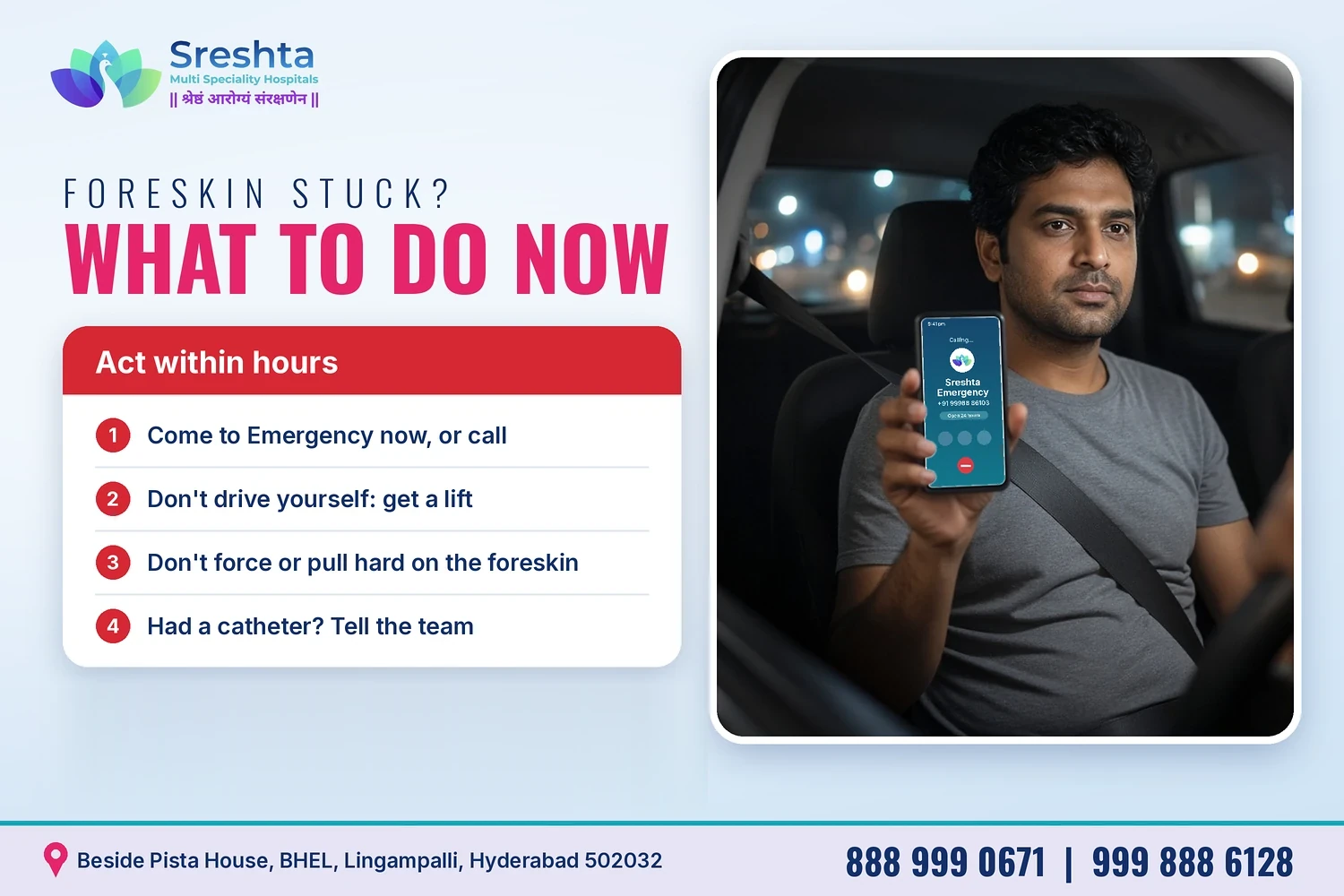
Go to the nearest Emergency department now, and do not drive yourself (NHS, 2026). Do not wait to see if the swelling settles on its own, because the swelling usually gets worse, not better.
- Come straight to Sreshta Emergency. The Emergency team is available 24 hours.
- Do not force the foreskin or pull hard on it. Forcing it can tear the skin.
- Remove any ring or tight object from the penis if you can do so easily.
- If you have a catheter, tell the team when and why it was placed.
How paraphimosis is treated at Sreshta
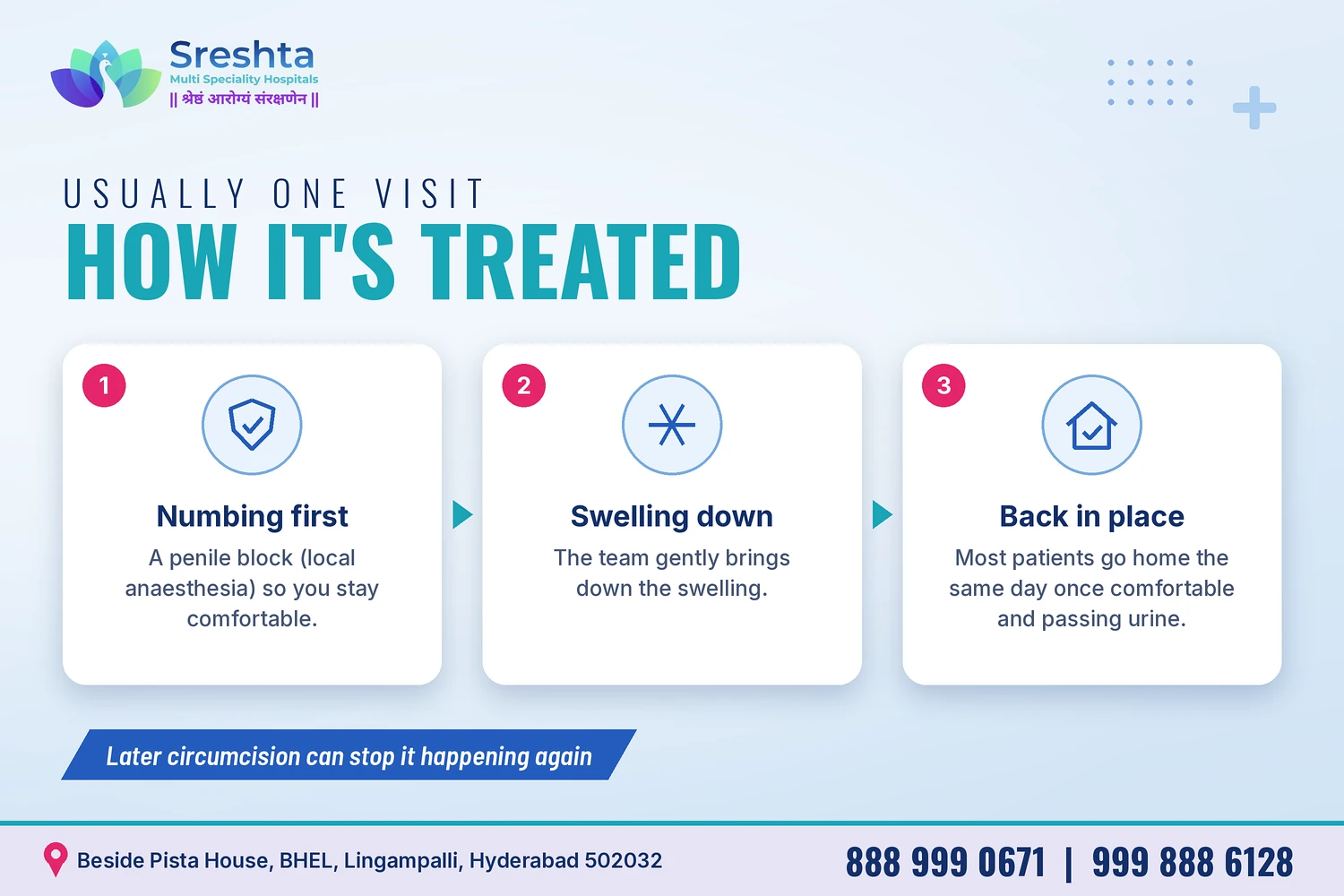
Treatment aims to bring the foreskin back over the glans as soon as possible and restore blood flow. The team starts with the gentlest method that works and moves to the next step only if needed (Choe, American Family Physician, 2000; EAU patient information, 2026).
| Step | What the doctor does | When it is used |
|---|---|---|
| 1. Pain relief | A penile block (local anaesthesia) numbs the penis. For children, a short general anaesthetic (GA) is preferred. | Almost every case, before the penis is handled |
| 2. Reducing the swelling | The team gently brings the swelling down | When the foreskin is too swollen to move |
| 3. Moving the foreskin back (manual reduction) | The doctor presses on the glans with the thumbs and brings the foreskin forward with the fingers | Once the swelling has gone down |
| 4. Small cut (dorsal slit) | A small cut in the tight band releases the pressure, and the wound is closed with dissolving stitches | When the band is too tight for steps 2 and 3 to work |
| 5. Circumcision | Removal of the foreskin at a planned later visit | To stop paraphimosis from happening again |
Patients go home the same day once the foreskin is back in place, they are comfortable and they can pass urine.
Circumcision after paraphimosis
Paraphimosis can come back. Circumcision at a later date stops it from happening again (Choe, American Family Physician, 2000). Your surgeon will advise whether you need it and when, once the swelling has settled.
At Sreshta, circumcision is done as a day procedure with an advanced 3rd generation gun stapler:
- You are given a penile block (local anaesthesia). For children, a short general anaesthetic is preferred.
- The surgeon removes the foreskin with the stapler, which cuts and closes the skin in one action.
- A light dressing is placed and is removed after 24 hours.
- You rest, are given pain medicine and go home the same day.
| When | What to expect and do |
|---|---|
| First 24 hours | Keep the area dry. The dressing is removed after 24 hours. |
| First week | Wear loose underwear. Take pain medicine as directed. No rest from daily activities is needed. |
| Weeks 1 to 2 | Swelling and a sensitive glans are normal. The silicone ring and pins fall off by themselves. No sport or heavy lifting. |
| At least 4 weeks | No sex or masturbation until the wound has fully healed. |
What happens if paraphimosis is not treated?
The tight band cuts off the flow of blood and fluid out of the head of the penis. Without treatment, the tissue of the glans can die (necrosis), and gangrene can follow within days or weeks (Choe, American Family Physician, 2000). Early treatment avoids this.
How to prevent paraphimosis
- Always bring the foreskin forward after washing, sex or masturbation.
- If you care for a man or boy with a catheter, check the foreskin is forward after every catheter change or wash.
- Have a tight foreskin examined and treated before it causes trouble.
- If you have had paraphimosis once, ask your surgeon about circumcision.
Paraphimosis care at Sreshta Multi Speciality Hospitals, BHEL
Paraphimosis is treated in the Emergency department and followed up in the General Surgery department at Sreshta Multi Speciality Hospitals, Ashok Nagar Colony, Ramachandrapuram, BHEL, Sangareddy, Telangana 502032.
| Details | |
|---|---|
| Emergency (24 hours) | +91 99988 86103 |
| Surgeons | Dr. K. Aravind Sagar, MBBS, MS (General Surgery), FISCP, D.MAS; Dr. K. Sravan Kumar, MBBS, MS (General Surgery), FISCP, D.MAS, FIGIES, WALS |
| Outpatient hours | 9am to 9pm, Monday to Saturday. Doctor availability changes by day, so call before you come. |
| Appointments | +91 99988 86128 or +91 88899 90671 |
| Message us on WhatsApp |
Key takeaways
- A foreskin stuck behind the head of the penis is an emergency. Come in within hours.
- Treatment usually takes one visit: numbing, bringing down the swelling and moving the foreskin back.
- A small cut is needed only when the band is too tight to move.
- Circumcision later stops paraphimosis from coming back.
Frequently asked questions
Can paraphimosis go back on its own?
Rarely. The swelling usually increases with time, which makes the foreskin harder to move. Do not wait; come to Emergency.
Can I push the foreskin back myself?
You can try once, gently, if it has only just happened. If it does not move easily, stop and come to Emergency, because forcing it can tear the skin.
Is treatment for paraphimosis painful?
The penis is numbed with a penile block (local anaesthesia) before the doctor handles it, so you should feel pressure rather than sharp pain. Children are given a short general anaesthetic.
Will I need circumcision after paraphimosis?
Not always. Your surgeon will advise circumcision if your foreskin is tight or paraphimosis has happened before, because circumcision stops paraphimosis from coming back.
Can paraphimosis happen in children?
Yes. It can happen when a boy’s foreskin is pulled back during bathing and not returned. Bring the child to Emergency; children are treated under a short general anaesthetic.
How much does paraphimosis treatment cost at Sreshta?
The cost depends on the treatment your doctor needs to give. Visit us or call, and the team will explain the charges for your treatment.
Foreskin stuck right now? Call Sreshta Emergency on +91 99988 86103. For a planned consultation about a tight foreskin or circumcision, call +91 99988 86128 or message us on WhatsApp.
Sources
- European Association of Urology. I want to know about paraphimosis. Patient information, updated September 2026.
- Choe JM. Paraphimosis: current treatment options. American Family Physician, 2000;62(12):2623-2626.
- NHS. Phimosis. Reviewed 6 March 2026.
Please read
This page gives general information in simple words. It is not advice for your own case. What is right for you depends on your examination and your reports. Your doctor will explain your options and you decide.